
Creating a great customer experience relies on making everyday interactions as effortless as possible.
When residents can report local issues without navigating long online forms or lengthy phone calls, they are far more likely to engage and share quality data.
In this edition of Solver Scoop, we’ll look at recent research into what customers expect of government websites, and explore how major utility providers are elevating CX with one simple change.
Inside this edition of the Scoop:
- What over 85% of customers actually want councils to prioritise
- How Yarra Valley Water improved customer satisfaction by streamlining online fault reporting
- How to bring speed and simplicity to your website’s reporting page
What your customers value most
When evaluating digital transformation initiatives, it’s natural to focus on internal processes: how quickly the right information gets to the right team, how easy it is for staff to do their jobs. But when the focus is inwards, organisations can lose site of the customer’s experience.
PwC Australia’s Citizen Survey highlighted a clear shift in what residents value most when they interact with service providers. The findings show that more than 85% of respondents rank speed and simplicity among their top priorities.
As Adam Lai, PwC Australia Partner and Global Head of Front Office Transformation, notes:
"Government would be well placed to focus on … simplifying channels."When it comes to designing webforms, councils should avoid focusing mainly on internal needs to also consider community expectations. The good news is, the two aren’t mutually exclusive.
How can you get there? Try user testing to understand your webforms’ ease of use, gather customer feedback through pop-up surveys, analytics and measurement tools, or mapping the customer journey to understand the user experience. With customer-centred insights, you’ll quickly see where the experience is succeeding or introducing friction, giving you a clear picture on where to focus your efforts.
How Yarra Valley Water re-evaluated their digital reporting channel
For Yarra Valley Water, traditional reporting pathways were creating unintended hurdles for their customers. Minor faults often went unreported because residents wanted to avoid a phone call, meaning small issues could regularly scale into larger operational challenges. Meanwhile, their customer service team worked hard to balance minor reports alongside urgent call outs.
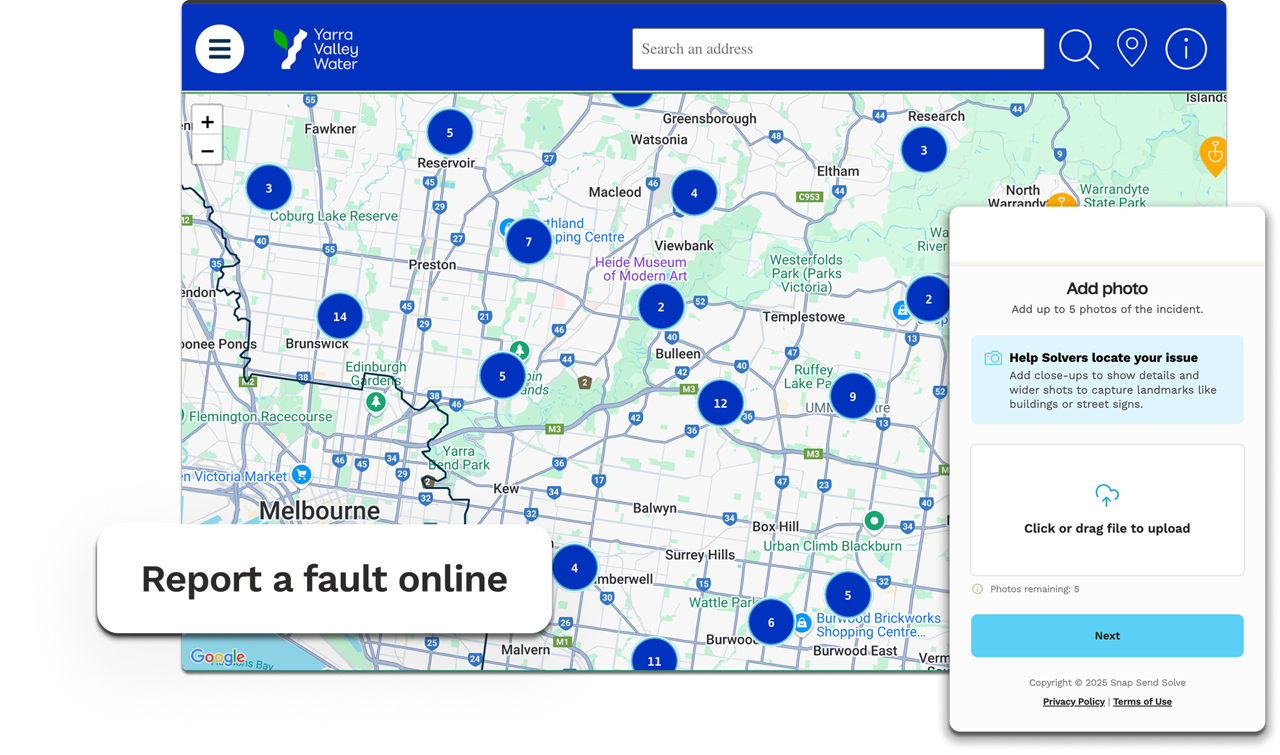
To address this, they focused on simplifying their Report a Fault web page by embedding the Snap Send Solve Webform alongside their live outage map.
Now, customers have a fast, intuitive, digital means for reporting faults. They can check the map for known issues, and if theirs isn't listed, submit a photo-driven report online in under 30 seconds.
Removing reporting friction delivered clear, measurable outcomes for their frontline operations:
- Reducing call volumes during peak periods, with the website now handling 9% of all fault reports.
- Catching minor issues early and preventing them from escalating, thanks to an effortless digital customer journey.
- Lifting customer satisfaction from 82% to 88%.
By re-evaluating their existing channels, Yarra Valley Water proved that making reporting simple and convenient is the key to elevating customer experience.
They’re not alone. South East Water and Greater Western Water also use Snap Send Solve’s Webform as their website’s primary fault-reporting tool. Together, Victoria’s "Big Three" water authorities are giving 5.1 million residents the ability to jump in and help look after local infrastructure via Snap Send Solve.
Bringing speed and simplicity to your website

When you’re looking for ways to improve your digital customer journey, your website is a great place to start. Residents visit your site wanting a quick way to let your team know about local issues, but online forms are often long and tedious.
They’re usually created by the single tool used to create all online forms for an organisation, via a the CRM or generic form builder. These tools usually which work well for permit applications, payments, or general enquiries, but are not purpose built for the mobile nature of reporting issues.
Our Webform, which can be embedded into your website, gives your community a seamless, reporting option that is built around convenience and speed. Residents can simply upload photos, pinpoint the exact location on a map using photo metadata and write a short description of the issue. With AI-suggested incident types and a thumb-friendly experience, it’s easy to submit a report in 30 seconds.
Updating your website channel with a journey purpose built for reporting issues makes it incredibly easy for residents to give you the right information the first time. Because the incoming reports arrive with clear images and precise data, it helps cut down on manual admin work and back-and-forth messages, making daily triage a lot smoother for your frontline staff.

Stay in the loop with insights that matter
Sign up for exclusive research, industry insights, and updates tailored for Solvers on the Snap Send Solve platform.